special interview
Special Interview - Tamaki Ishigaki (Part 2)
Serialization, and the Gaiden Trilogy
──The Gaiden series ultimately became a long-running story spanning three parts and six collected volumes.
During Gaiden, since each chapter was 24 pages, I imposed a self-rule similar to robot anime: every single chapter had to feature at least one action sequence. Otherwise, it wouldn't be entertaining. If it was just idle dialogue dragging on and on, people would get bored. So, taking cues from robot anime, I made sure a few pages within those 24 pages were strictly dedicated to sword fights and battle scenes. However, the final volume of Castle of the Avenger (Part 3) had nine chapters instead of eight. There was an episode I desperately wanted to include, so I consulted the editor-in-chief. He said one extra chapter would be fine. It was originally in the plot, and while I could have cut it, I really wanted to show what the non-combatants were doing while the main fighters were battling. Up until then, both the three volumes of the main story and the three parts of Gaiden had just rushed to the finish line. Because of page limits, there was no room to depict what anyone else was doing. Even if it existed in the plot, I had slashed it all away.
──So you decided to include it at the very end?
Yes, that's right. Though in truth, the last two chapters still turned into a digest. I crammed in content that couldn't naturally fit into 24 pages. I wanted to draw the fall of the castle much more dramatically, but I had to squeeze it into two pages... That remains a slight regret. If it had been published in a dedicated manga magazine, I might have been able to extend it by two chapters, but since we were just borrowing space in a video game info magazine, I couldn't be too demanding.
Armor Design
──Were there any other struggles when adapting a game like Wizardry into a comic?
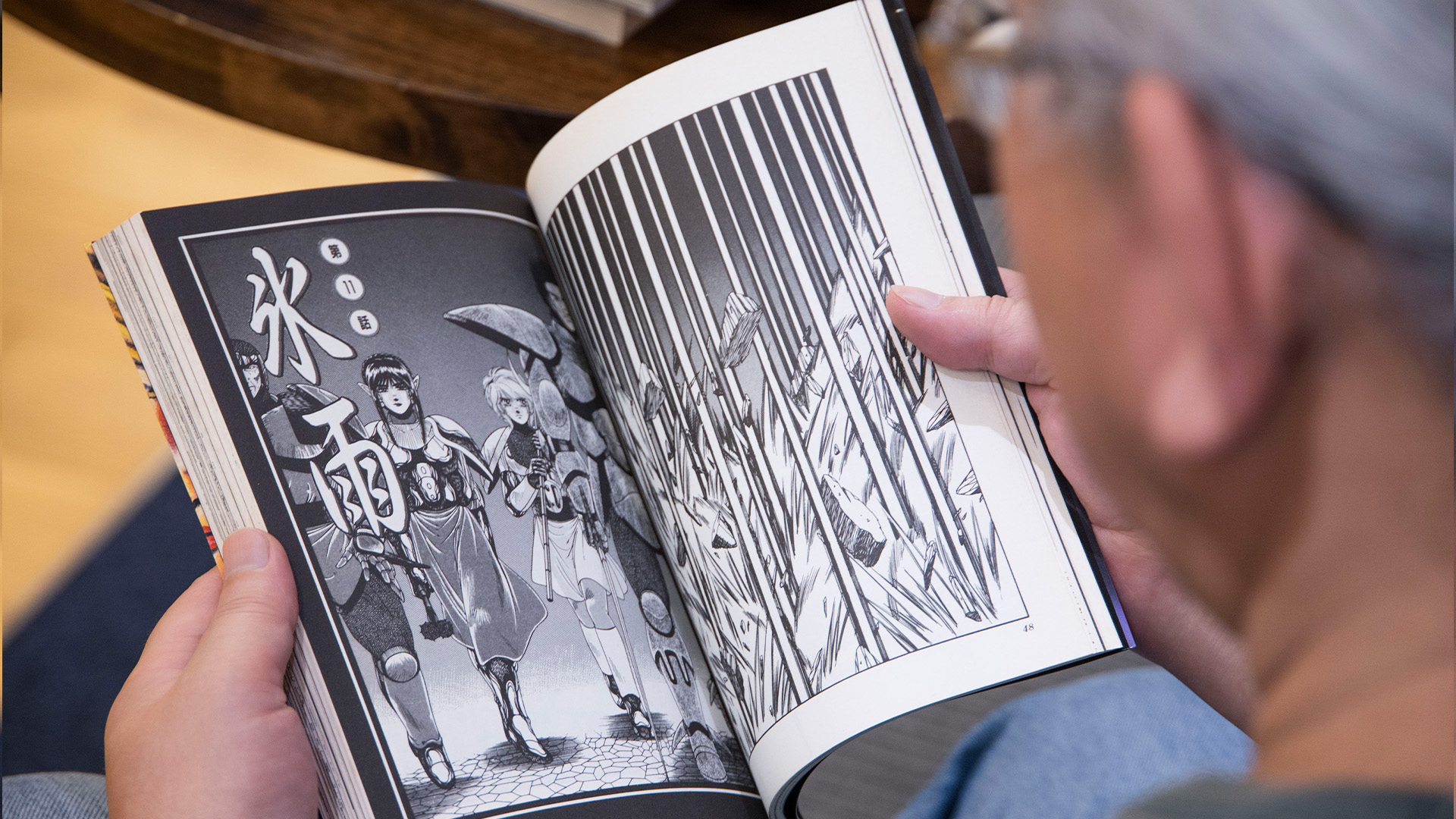
As for struggles, putting intricate patterns on the armor was fine, but when I handed the pages to assistants, they frequently got the patterns wrong. Drawing the patterns myself because it was annoying ended up taking even more time. So for Gaiden, I decided to keep things as simple as possible. However, since most armor back then was symmetrical, I went with asymmetrical designs instead—which turned out to be another huge mistake that just cost extra time and effort. Near the end of Gaiden Volume 1, when the armor broke, I vividly remember being overjoyed that I wouldn't have to draw asymmetrical armor anymore! (laughs)
──So there was real obsession and painstaking effort behind the designs.
By the way, the armor was modeled after Buddhist statues—specifically life-sized statues like the Twelve Heavenly Generals. I've always loved Buddhist statues.
Influences and Inspirations
──You wrote that you weren't actually that fond of the fantasy genre, yet you seem quite particular about it.
Well, I loved Michael Moorcock's The Eternal Champion series. I was a huge fan of Yoshitaka Amano's art, and a big part of it was falling in love with his character designs. They were so cool. My favorite era of Amano-san's art style was when he was illustrating Corum (Editor's Note: Moorcock's The Chronicles of Corum series translated into Japanese by Hayakawa Shobo). As for fantasy, I did read it. I read all of Lord Dunsany's works, too.
──In your comics, the monsters of the Wizardry world are grouped together as "Ancient Ones sealed away by the Light in ancient times." Settings like that inevitably remind me of H.P. Lovecraft...
Ah, I absolutely love Cthulhu! I own all the paperbacks published by Tokyo Sogen-sha, Seishinsha, and the like. Using the term "Ancient Ones" was just my way of dropping a subtle hint, though.
──Could it be that the Book of Summoning held by Gil in Gaiden was actually...
That was based on The Evil Dead, I think—the one with a human face on it (Editor's Note: Refers to the forbidden book Book of the Dead / Necronomicon Ex-Mortis from The Evil Dead film series). That, plus the book Megapolisomancy from Fritz Leiber's novel Our Lady of Darkness. When I read that, I thought, "Man, I want to write something like this!" Throughout high school and university—I was in college for six years—I read over 300 books a year, not counting magazines and manga. I also liked Anne McCaffrey's Dragonriders of Pern. Though everything after the initial trilogy has been sitting unread on my bookshelf for decades.
The Japanese-Style Gaiden Series
──Starting from Part 2, Wizardry Gaiden was set in a Japanese-style country, making it quite unique for a Wizardry spin-off. I recall reading somewhere that you like period dramas (jidaigeki). Did you prefer Eastern-style stories over Western ones?
Yes. Western-style fantasy feels heavy and hard for me to draw. In my head, Hourai—the setting for Gaiden Part 2—existed back when the Japanese archipelago was still connected to the mainland and the Sea of Japan was an inland sea. There was a concept of "Wa" (harmony/Japan), and Hourai was part of it, as was Hidakami which appeared later, and Izumo was also a part of it. I built up all those lore settings all at once. The Kusanagi Sword was actually a red herring—it was a tsukumogami (tool spirit). It once had a physical shape, but having lost its form, only its will remained. That's why it became armor—bearing only the name "Kusanagi." Originally, swords in Japanese mythology didn't have many specific names—just things like Totsuka-no-Tsurugi, Ama-no-Murakumo-no-Tsurugi, or Ama-no-Habakiri. Beyond that, they just became deities, like Futsunushi-no-Kami. Ama-no-Murakumo-no-Tsurugi was too long, so I chose the shortest one. That was something I was told back when I wrote for Sunday: "Keep dialogue to a maximum of 8 characters per line. If speech bubbles get too wordy, people stop reading." So I was advised to keep names short too.
──I see! That's why it became "Kusanagi."
Speaking of period dramas, near the end of Tower of the Phoenix, JICC Publishing released a magazine called Fantasyland. Apparently, it sold out immediately in major metropolitan areas but failed miserably in rural regions, so the editor-in-chief got angry and never published a second issue. I wrote a 48-page one-shot for it (Editor's Note: Wizardry Gaiden: Book of Summoning), but because it was a last-minute request, I used Mito Komon as a motif. Also, I actually introduced the armor from Castle of the Avenger early in that issue. Remember how the Toei Manga Matsuri used to do crossover previews? Like in Mazinger Z vs. Dark General, where they showed Great Mazinger before it aired on TV. I was aiming for a trick like that... but nobody seemed to notice, so there was zero reaction! (laughs)
──I-Is that so?! (sweats)
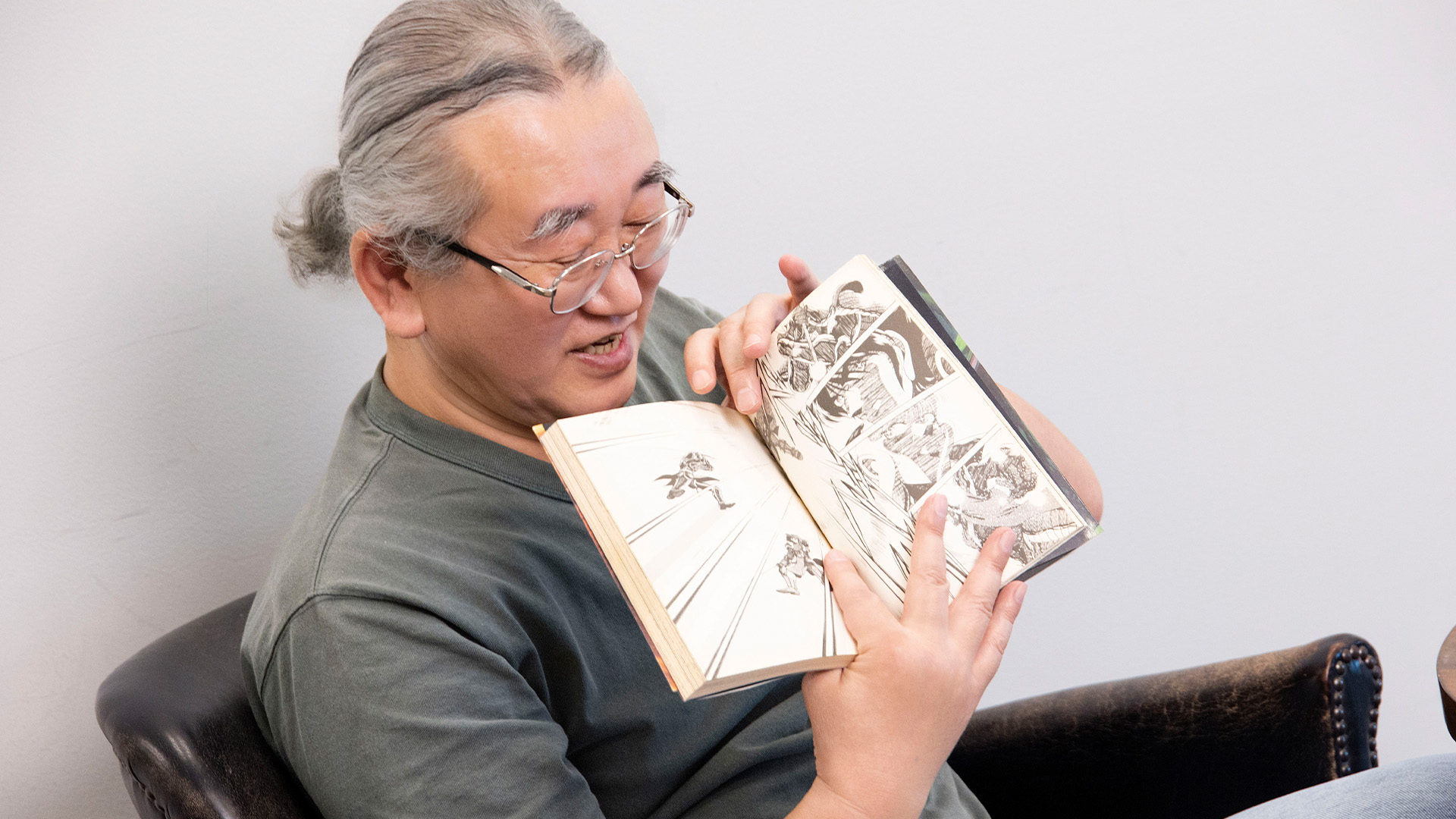
Also, the visual composition for Gaiden was inspired by Yasujiro Ozu throughout the entire run: low-angle, head-on shots. I decided from the start to do action scenes that way. There was also a scene that paid homage to director Seijun Suzuki's Branded to Kill. There's a shot where the camera shoots from underneath a glass floor, and I copied that directly for a two-page spread. I happened to watch the movie while working and wanted to try it, but I couldn't make it in time for the magazine serialization, so I drew it with a normal composition. Later, the editorial team lost that exact manuscript, so I had to redraw it for the graphic novel release. I thought, "What a perfect opportunity!" and took advantage of it (laughs).
──That was an extremely fascinating story.
After all that, the serialization ended. Originally, there were plans for comic adaptations of Wizardry III: Legacy of Llylgamyn and Dark Lord (Editor's Note: A Famicom RPG released by Data East in 1991). However, right at that moment, JICC Publishing pulled out of the comic business... so that was the end of it. But a college junior from my anime club was working at Fujimi Shobo, and he reached out saying, "We're launching a new card game, but we are desperately short on illustrators."
──Monster Collection, right? So one way or another, fantasy jobs kept coming your way.
They said they preferred artists with experience drawing fantasy. It was a job I received precisely because I had drawn Wizardry, for which I'm deeply grateful.
Message for the 45th Anniversary

──Finally, as Wizardry celebrates its 45th anniversary, do you have a message for the fans?
Let's see... It's been 38 years already, huh? My eldest son, who was born while I was drawing it, is 38 now. Man, when I first became a manga artist, I thought of myself as akin to an Kibyoshi author from the Edo period (Editor's Note: Kibyoshi were illustrated storybooks popular in the mid-Edo period). Despite being eagerly read by the general public, no Kibyoshi authors' names survive today. At best, Nanso Satomi Hakkenden (Editor's Note: Strictly speaking, Hakkenden belongs to the Yomihon genre, not Kibyoshi) barely remains, while everything else got buried... But I was fine with that. Even if I was forgotten after two or three years, I thought that was just the true nature of fad pop culture. Fads fade away eventually. So the fact that Wizardry hasn't disappeared after 45 years and still remains is incredible in itself. Devoted fans are still doing dojin activities today. Also—and this might be a message for Drecom—since Wizardry was originally a game, I really think they should keep releasing games.
──They currently have Wizardry Variants Daphne running, but rather than stopping there, you hope for the next game.
Exactly. I want them to keep making Wizardry games.
──Thank you so much for your time today!
Chronological Reference Timeline
- Nov 1985 Japanese PC version of Wizardry released.
- Mar 1986 Monthly Famicom Hisshoubon first launched (Takarajimasha, JICC).
- Sep 1986 Famicom Hisshoubon becomes a biweekly magazine.
- Dec 1987 Famicom version of Wizardry released.
- Feb 1988 Famicom Hisshoubon Vol. 5 begins serialization of Neighboring Gray and Youth.
- Aug 1988 Naruharu Tanaka publishes Ultima: Terror of Exodus.
- Oct 1988 Tamaki Ishigaki's Wizardry Vol. 1 published.
- Jan 1989 Wizardry Vol. 2 published.
- Jun 1989 Wizardry Vol. 3 published.
- Aug 1989 (?) Wizardry Gaiden serialization begins in the Oct 20 issue.
- Feb 1990 Wizardry Gaiden Part 1: Labyrinth of Gil published.
- Aug 1990 Wizardry Gaiden Part 2: Tower of the Phoenix (Part 1) published.
- Dec 1990 Famicom Hisshoubon rebrands as HiPPON SUPER! and becomes a monthly magazine.
- Feb 1991 Wizardry Gaiden Part 2: Tower of the Phoenix (Part 2) published.
- Oct 1991 Wizardry Gaiden Part 3: Castle of the Avenger (Part 1) published.
- May 1992 Wizardry Gaiden Part 3: Castle of the Avenger (Part 2) published.
- Feb 1993 Wizardry Gaiden Part 3: Castle of the Avenger (Part 3) published.
What is the Wizardry Manga Adaptation?
In the late 1980s, Famicom Hisshoubon—published by JICC Publishing—was a gaming magazine that heavily featured the 1987 Famicom port of Wizardry, attracting a large fan base. Tamaki Ishigaki's comic adaptation of Wizardry was published by the Hisshoubon editorial department as an original three-volume release. The subsequent Gaiden series—featuring an original story serialized in the magazine—spanned six collected volumes across three parts.